 SynapTree
SynapTree
SynapTree
SynapTree is a narrative architecture tool for writers, screenwriters, game designers, and worldbuilders. Map your characters, locations, events, and the relationships between them -- and finally see your story as a whole.

Free tier included. No account required.
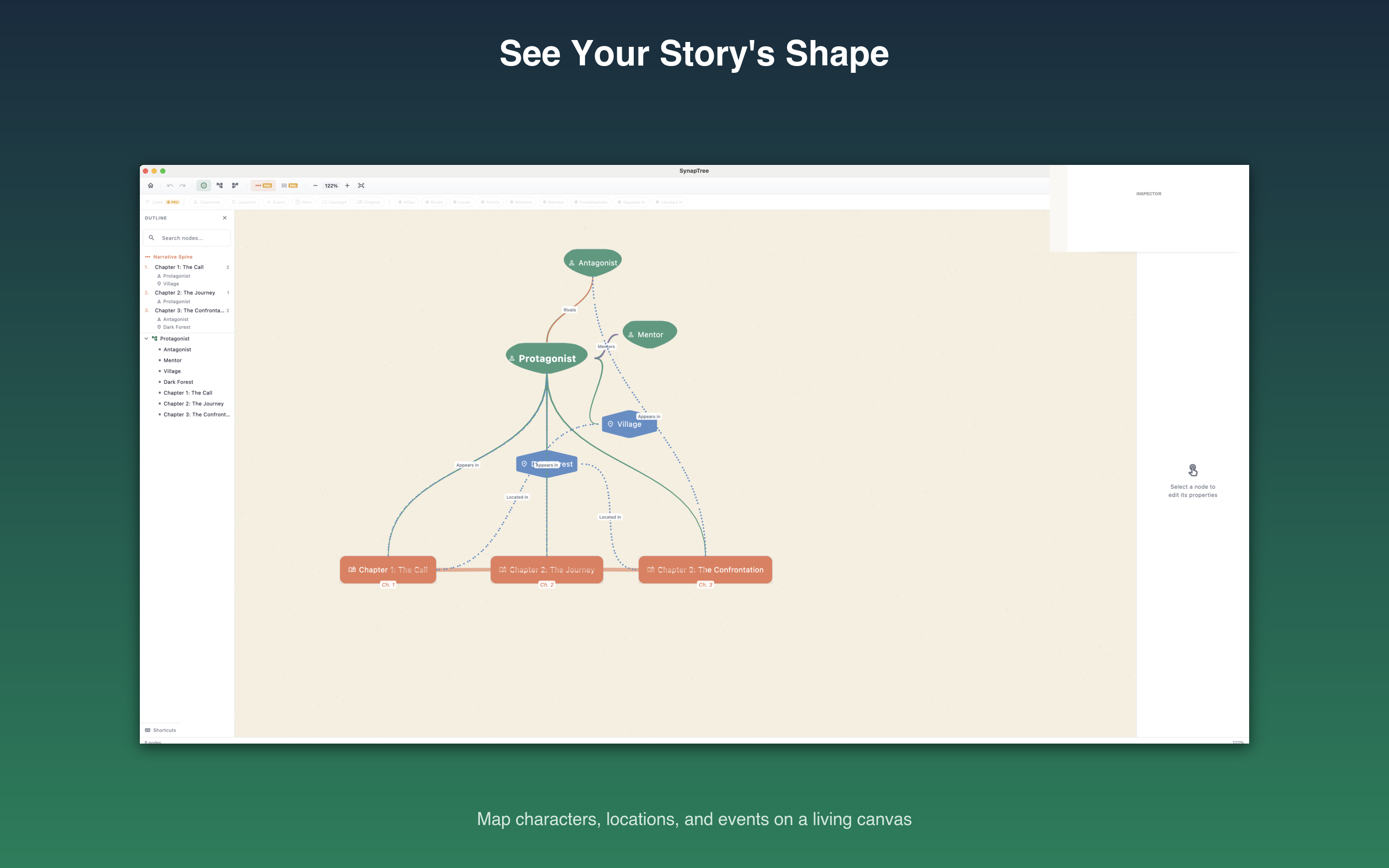
You are deep into Act Two. Your protagonist's mentor has just betrayed them. But wait -- did the mentor ever actually meet the antagonist? Which chapter introduced that subplot about the stolen artefact? And is the tavern in the capital city or the border town?
Your story outgrows your tools. Word docs, spreadsheets, and sticky notes collapse under the weight of a complex narrative. Characters multiply. Subplots tangle. Continuity errors breed in the dark corners you cannot see.
Relationships are invisible. Your protagonist and antagonist share a mentor. That changes everything about Act Three. But your outline does not show you this -- it is locked in your head, and it is the first thing your brain forgets under deadline pressure.
Existing tools do not understand stories. Mind maps give you boxes and lines. Scrivener gives you text. Neither understands that a Character, a Location, and an Event are fundamentally different things -- or that the connection between them is what makes a plot.
Plot holes find your readers before you do. Every relationship you forgot to track is a one-star review waiting to happen. Every timeline inconsistency is a reader who puts your book down and never picks it back up.
"I just found a massive plot hole in chapter 37. My mentor character appears in two places at once. I have to rewrite three chapters." -- Every novelist, at least once.
It is not a mind map. It is not an outliner. It is a narrative architecture tool -- purpose-built for people who think in connections, not paragraphs.
Lay out your characters, locations, events, and chapters as living nodes on an infinite canvas. Then draw the relationships between them -- not just "connected" but how they are connected. Allies. Rivals. Foreshadows. Betrays. Each relationship has meaning, and SynapTree makes that meaning visible.
See your story as a whole ecosystem. Find the gaps before your readers do.
Every node type has its own organic shape, colour, and type-specific fields. Your canvas looks like a living world, not a corporate whiteboard.
Leaf-shaped, moss green. Name, role, description.
FREEHexagonal, slate blue. Name, description, atmosphere.
FREEDiamond, amber. Name, when, description, outcome.
FREEAcorn circle, honey. Name, significance, owner.
PROOrganic cloud, lavender. Track your themes.
PROFolded page, terracotta. Title, number, summary.
PROEvery feature exists to make the invisible structure of your story visible.
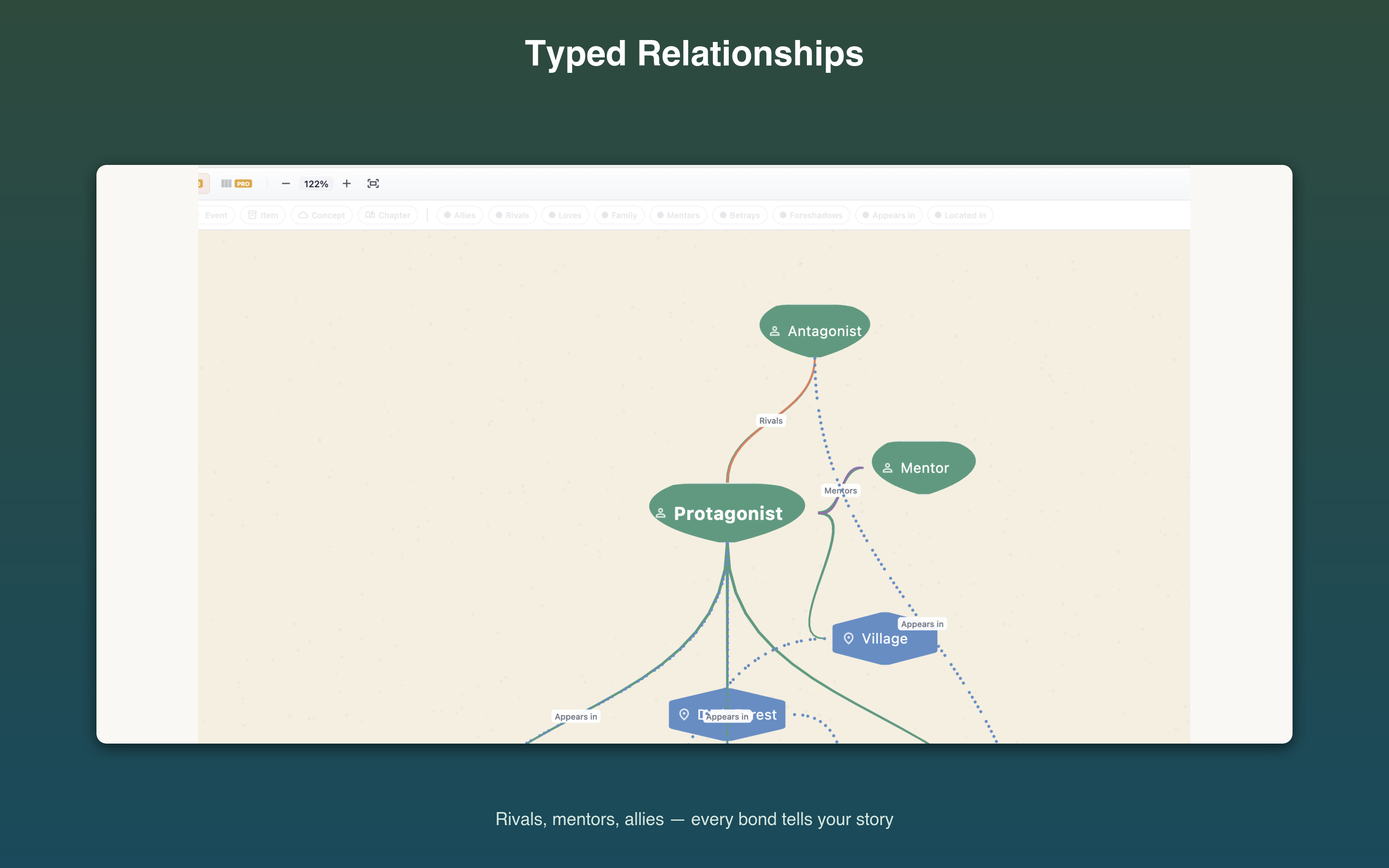
This is what separates SynapTree from every other tool. Connections are not just lines -- they are narrative relationships with types, visual styles, and labels. Allies, Rivals, Mentors, Foreshadows, Betrays, Appears In, Located In.
Press R, drag to another node, pick the relationship type. Done. No forms. No dialogs. Just story architecture at the speed of thought.
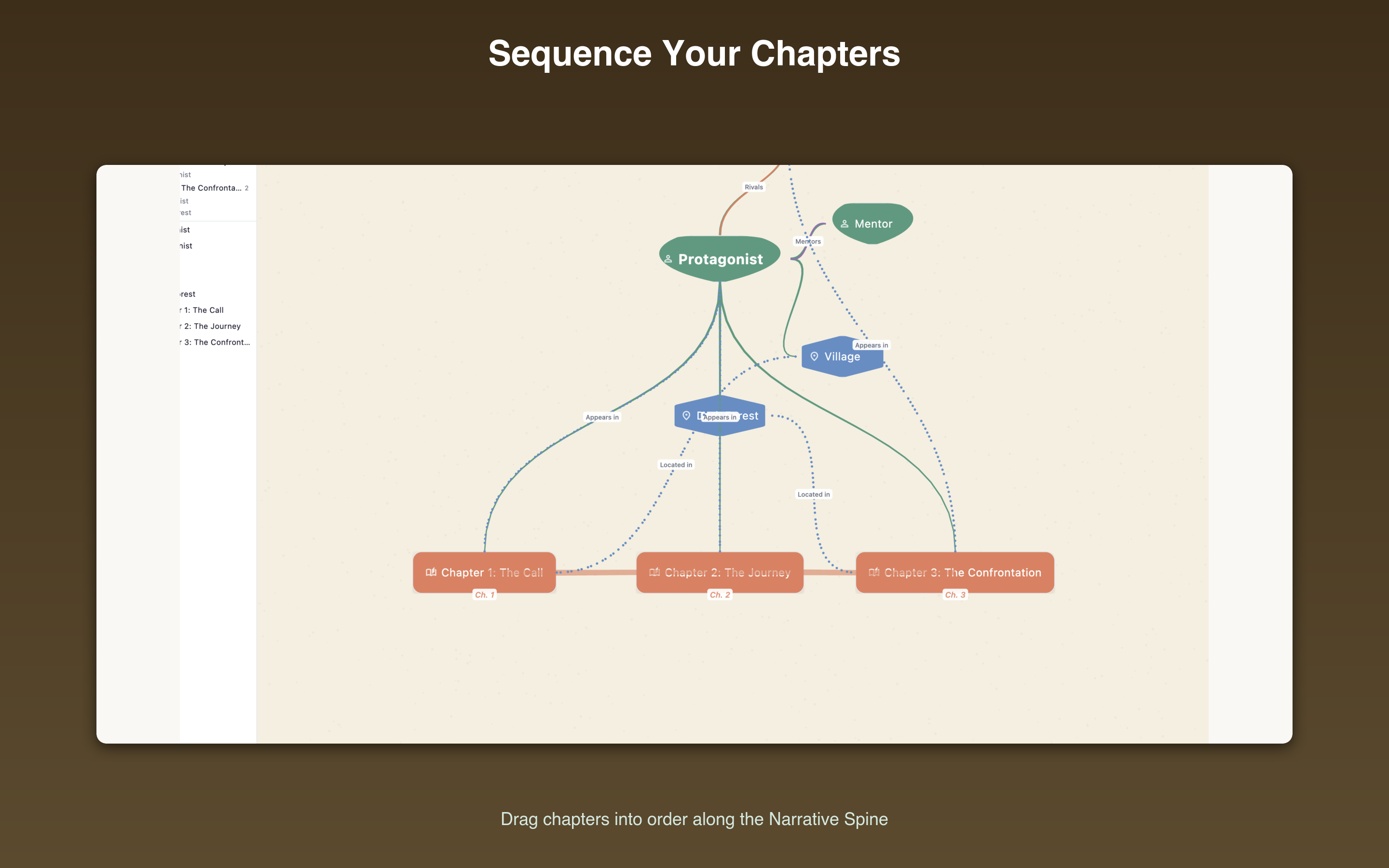
Toggle a horizontal or vertical story spine that runs across your canvas, anchoring Chapter nodes in narrative order. Drag chapters along the spine to reorder your plot. All connected characters and events rearrange around the new structure.
See your entire three-act structure at a glance. Find the weak spots before your beta readers do.
SynapTree scans your map and flags potential narrative gaps: characters with no relationships, locations no one visits, events that appear disconnected from your plot, and chapters missing key story elements.
It will not write your story for you. But it will tell you where the holes are -- before your readers find them.
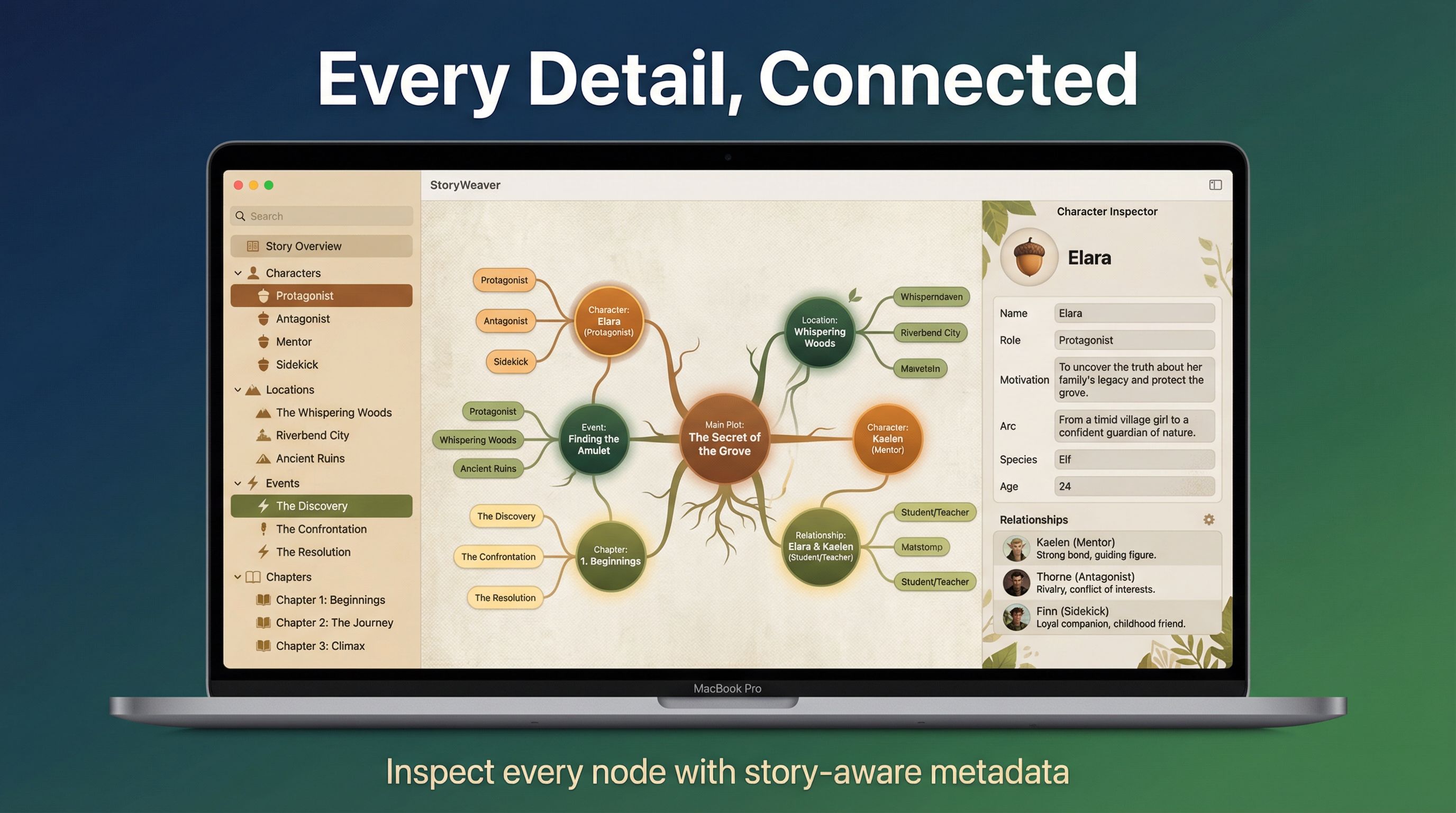
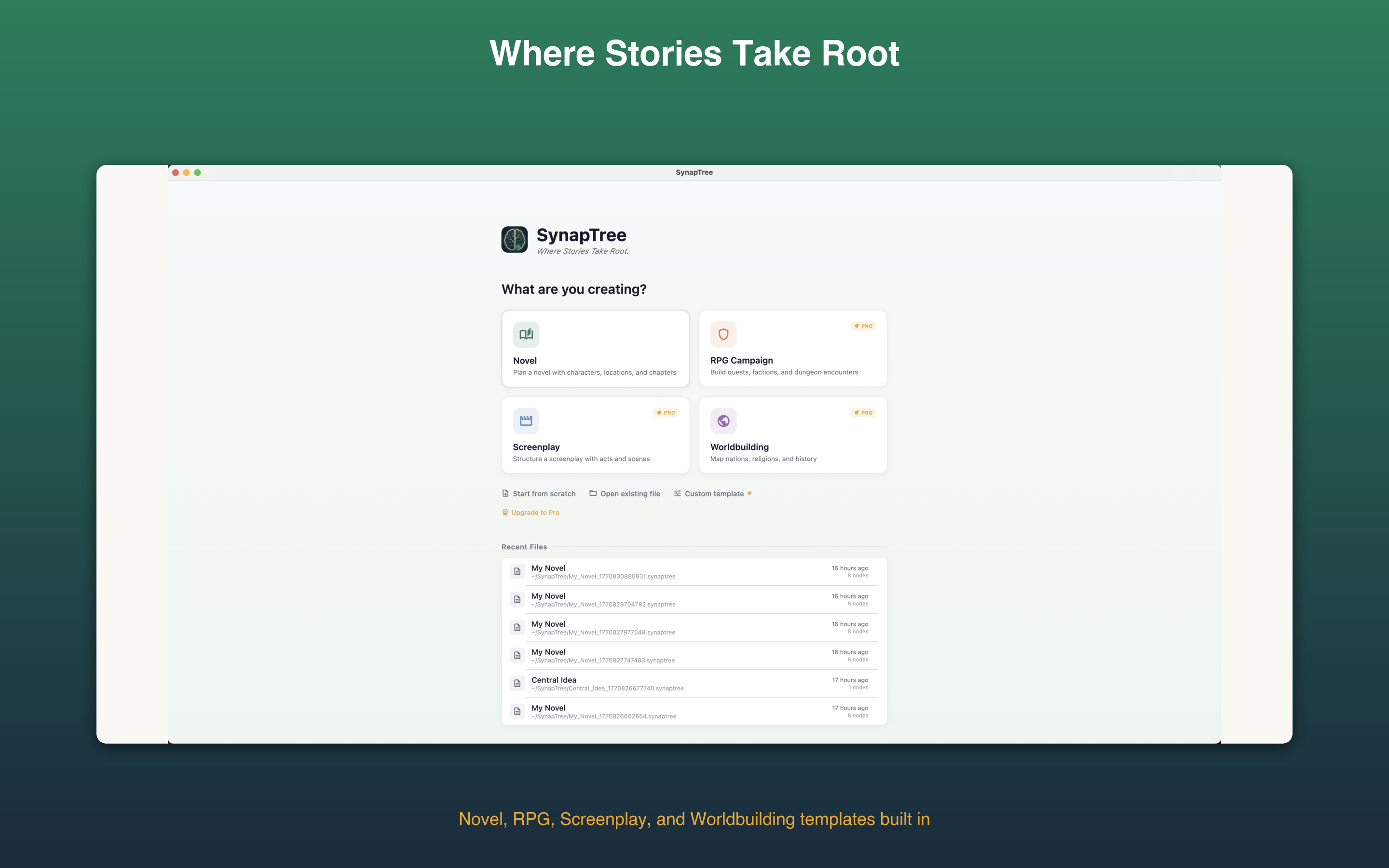
Start with a template built for your genre. Novel, Screenplay, RPG Campaign, or Worldbuilding -- each comes with pre-configured relationship types and a starter map you can modify or discard.
Pro users can create custom templates with bespoke node types, relationship types, and structures tailored to any project.
Filter your entire map by character arc, theme, location, or any other criteria. Toggle Story Lens to dim everything except the nodes and relationships you care about right now. Trace a single character's journey through your entire plot without the noise of everything else.
Export your maps as PNG, SVG, PDF, Markdown, or JSON. Import from FreeMind, OPML, or Markdown outlines. SynapTree plays nicely with whatever tools you already use -- it does not try to replace your writing app, just the planning stage that comes before it.
I have always been someone who thinks in webs, not lists. When I am working through an idea -- whether it is an app I am building or a story I am noodling on -- my brain does not produce neat outlines. It produces tangles. Character A knows Character B who once lived in Location C which is connected to Event D and, honestly, by the time I have written that sentence I have already lost the thread.
I tried every mind mapping tool out there. They were fine for meeting notes and project plans, but they all felt wrong for stories. They treated connections as afterthoughts -- just lines between boxes. But in a story, the connection is the whole point. Whether Marcus and Elena are allies or rivals changes everything about your plot.
So I built SynapTree. It is the cartographer's desk for your fictional world. You lay out characters, locations, events, and chapters as living, breathing nodes on a canvas. Then you draw the relationships between them -- not just "these are connected" but how they are connected. Each relationship has meaning, and SynapTree makes that meaning visible.
One payment. Everything below. Yours forever.
Your Price
$24.99
One-time purchase. No subscription. No recurring fees ever.
Less than a month of Netflix -- for a tool that makes your stories structurally bulletproof.
Free tier included. The manual is here if you want to read first.
The free tier is not a crippled trial. It is a real tool for real writers.
Free, forever
$24.99 one-time
Scrivener and yWriter are brilliant writing tools -- they handle manuscripts, chapters, and research. SynapTree is not a writing app. It is a planning and architecture tool. You use SynapTree to map out your story's structure, characters, and relationships visually before you start writing. Then you open Scrivener to write the actual prose. They complement each other perfectly.
Generic mind maps treat everything as the same kind of box with the same kind of line. SynapTree understands that a Character is different from a Location, which is different from an Event. Each has its own shape, colour, and fields. Connections are not just lines -- they are typed relationships like "Allies," "Betrays," or "Foreshadows." This narrative awareness is the difference between a diagram and a story architecture tool.
Yes, currently SynapTree is a native macOS application. It is built with Flutter, which means iPad and potentially other platforms are on the roadmap, but for now we are focused on making the macOS experience exceptional before expanding.
SynapTree uses its own .synaptree format (JSON compressed with gzip). Your files are yours -- they are stored locally on your Mac, not in the cloud. You can also export to PNG, SVG, PDF, Markdown, or JSON at any time, and import from FreeMind, OPML, or Markdown outlines.
No. It is a one-time purchase of $24.99. You pay once, you get everything -- including all future Pro features. No subscriptions, no recurring fees, no "premium tiers" that keep charging you every month. We believe creative tools should be owned, not rented.
Absolutely. The RPG Campaign template comes with relationship types like "Quest Giver," "Guards," "Member of," and "Rules Over." You can map factions, dungeons, NPCs, quests, and loot in a way that makes the whole campaign visible at once. Several of the Pro templates were designed with game masters in mind.
The free tier allows up to 50 nodes per map, which is enough for a short story, a screenplay outline, or the first act of a novel. If you need more, the Pro unlock removes the limit entirely -- unlimited nodes, unlimited complexity, unlimited stories.
Your characters have relationships. Your locations have histories. Your events have consequences. It is time you had a tool that understood that.
Free tier included. No account required.